Effective reduction of inflammation and pain associated with musculoskeletal disorders and degenerative joint disease in dogs, as well as dependable post-operative pain management following parenteral analgesia.
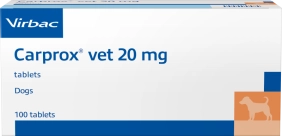
Carprox is a prescription non-steroidal anti-inflammatory drug (NSAID) containing carprofen, specifically formulated for dogs. Delivered in palatable, meat-flavoured, round scored tablets, Carprox vet provides anti-inflammatory, analgesic, and antipyretic activity to help manage chronic osteoarthritis, acute musculoskeletal pain, and post-surgical recovery.
Available in Authorised as a prescription-only veterinary medicinal product (POM-V) in the United Kingdom.
Contact support teams with any question by phone or via our quick form.
Formulation: Round, dark brown, marbled tablets with visible darker spots, one-side scored and bevel-edged.
Strengths: 20 mg, 50 mg, and 100 mg carprofen per tablet.
Packaging Formats: OPA/Al/PVC-Al blister strips (10 tablets per strip) packaged in cartons containing 20, 50, 100, or 500 tablets.
Targeted Joint and Muscle Relief: Approved for the reduction of inflammation and pain caused by acute or chronic musculoskeletal disorders and degenerative joint disease (osteoarthritis) in dogs.
Seamless Post-Operative Continuity: Formulated as an effective oral follow-up to parenteral analgesia to maintain consistent, reliable management of post-operative pain
Proven Triple Action: Carprofen provides robust anti-inflammatory, analgesic, and antipyretic activity. It operates as an inhibitor of the cyclo-oxygenase (COX) enzyme in the arachidonic acid cascade.
Targeted Mode of Action: While its precise mechanism is unclear, carprofen's inhibition of prostaglandin synthesis is slight in relation to its anti-inflammatory and analgesic potency.
Stereoselective Potency: Carprox vet is a chiral drug. The S(+) enantiomer is more active than the R(-) enantiomer, and there is no in-vivo chiral inversion between them.
Rapid Onset & Excellent Bioavailability: It is highly bioavailable and rapidly absorbed after oral administration (>90%). Dogs achieve peak plasma concentrations within 1 to 3 hours post-administration.
Convenient Half-Life for Flexible Dosing: Carprofen features a plasma half-life of approximately 10 hours in dogs, supporting a flexible daily therapeutic regimen (either as a single daily dose or split into two equal parts).
Hepatic Elimination: The active ingredient is metabolised via biotransformation in the liver and excreted primarily in faeces (70–80%) and urine (10–20%) with some enterohepatic circulation detected.
Proven Overdose Tolerance: Clinical safety trials demonstrate excellent tolerance. Dogs treated at 3 times the standard dose (6 mg/kg twice daily for 7 days) and 1.5 times the standard dose (6 mg/kg once daily for an additional 7 days) showed no signs of toxicity.
Carprofen
Initial Therapy: 2 to 4 mg carprofen per kg bodyweight per day, administered orally as a single daily dose or divided into two equal doses.
Maintenance Therapy: Subject to clinical response, the dosage may be reduced after 7 days to 2 mg carprofen/kg bodyweight/day given as a single daily dose.
Post-Operative Follow-Up: Following parenteral analgesia, oral tablets may be administered at 4 mg/kg/day for up to 5 days to extend pain relief.
Treatment Duration: Dependent on clinical response; however, the dog's condition should be re-appraised by a veterinary surgeon after 14 days of therapy.
Oral administration. Tablets can be divided into two equal parts to adjust dosage.
Clinical Precautions: Use in aged dogs involves additional risk and requires careful clinical management. Avoid use in dehydrated, hypovolaemic, or hypotensive animals due to potential renal toxicity risks. In cases of bacterial infection, initiate concurrent antimicrobial therapy.
Drug Interactions: Do not administer other NSAIDs or glucocorticoids concurrently or within 24 hours. Avoid concurrent administration of potential nephrotoxic drugs.
User Safety: Wash hands after handling. In case of accidental ingestion, seek immediate medical advice and show the product package leaflet or label.
Storage Requirements: Do not store above 25 °C. Store blister strips inside the outer carton to protect from light and moisture. Halved tablets returned to the opened blister must be used within 24 hours. Product shelf-life is 3 years.
What target species is Carprox vet authorised for?
Carprox vet is strictly indicated for dogs. It is contraindicated and must never be used in cats.
Can Carprox vet tablets be split for accurate dosing?
Yes, Carprox vet tablets feature a scored and bevel-edged design that allows them to be divided into two equal parts for accurate weight-based dosing. Halved tablets must be replaced in the opened blister and administered within 24 hours.
How should Carprox vet be used following surgery?
To extend post-operative pain management following initial parenteral analgesia, Carprox vet tablets can be given orally at 4 mg/kg bodyweight daily for up to 5 days.
Can Carprox vet be co-administered with other anti-inflammatory medications?
No. Do not administer other NSAIDs or glucocorticoids concurrently or within 24 hours of administering Carprox vet.
Is Carprox vet suitable for pregnant or breeding dogs?
No. Safety during pregnancy and lactation has not been established, and laboratory studies showed evidence of foetotoxic effects at near-therapeutic doses. Do not use in pregnant or lactating bitches.
Too many requests
Details: cache-iad-khef600077-IAD 1794979745 2643829235
Varnish cache server