
Professionals
Product information
Reproduction Range Brochure
File type: PDF
File size: 1.3 MB
Along with positive socialisation, training and appropriate nutrition, castration is often considered a key component of responsible dog ownership. As well as preventing accidental mating, castration can be beneficial in preventing specific testosterone related disease and can help in the management of some behavioural issues.
Published 21.04.2020
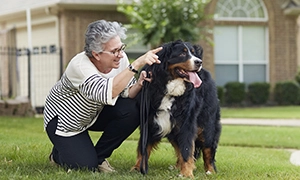
However, whilst these are valid reasons for castration, a recent survey showed that 25% of pet owners are concerned or very concerned that neutering could be harmful for their dog1. Common concerns cited included the potential risks involved with a surgical procedure and that their dogs’ behaviour would be affected adversely. The permanency of surgery was also the reason for 67% of owners with entire male dogs not opting for surgical castration2.

Suprelorin® implants are licenced for the induction of temporary infertility in healthy, entire, sexually mature male dogs. This offers both vets and owners an alternative to surgical castration, conferring the benefits of neutering without the permanency. This can be helpful in situations where owners wish to ‘try before they buy’ in order to see how their dog would behave once castrated, or if they only wish for temporary effects. This article will outline the Normal reproductive physiology of the male dognormal reproductive physiology of the male dog, the mechanism of action of Suprelorin and the clinical effects of the implant.
The two principal functions of the male reproductive system are to produce sperm and the steroid hormone, testosterone. The gonadotrophins, luteinising hormone (LH) and follicle-stimulating hormone (FSH), are secreted by the anterior pituitary gland in response to gonadotrophin-releasing hormone (GnRH) production from the hypothalamus, which is released in an episodic manner. In the testes, LH binds to receptors on Leydig cells and stimulates the synthesis and secretion of testosterone. In addition to its systemic effects, testosterone also acts locally in conjunction with FSH to support spermatogenesis through stimulation of the Sertoli cells in the testis. There is an integrated negative feedback system for the control of hormone secretion; testosterone and its metabolites oestradiol and dihydrotestosterone provide negative feedback at the level of the hypothalamus and the pituitary gland. This contributes to the regulation of GnRH release and therefore regulation of the gonadotrophins, LH and FSH. In addition, other hormones such as activin (stimulating effect) and inhibin (inhibiting effect) can exert selective effects on FSH without affecting LH levels therefore the concentrations of LH and FSH do not always rise in parallel despite the linkage of control through the common feedback loop.
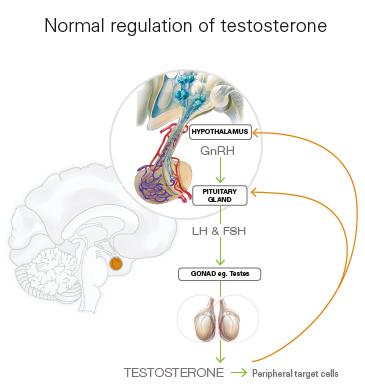
The average testosterone level in entire, adult male dogs ranges between 2-4ng/ml but it is important to appreciate that this is highly variable and can fluctuate considerably even within a 24-hour period3. However, despite this variation, fertile dogs with normal libido rarely show testosterone concentrations of less than 0.4ng/ml. Once levels of testosterone reach <0.4ng/ml, this tends to result in infertility due to reduced spermatogenesis, reduced ejaculate volume, reduced sperm motility, increased sperm abnormalities and reduced libido.
Suprelorin contains the active ingredient, deslorelin, in a lipid matrix biocompatible implant. Deslorelin is a GnRH superagonist created by modifying the amino acid sequence of endogenous GnRH at positions 6 and 9. This results in a compound with the same action as GnRH but with 7-fold increased GnRH receptor binding affinity, increased stability and increased potency4. Although more stable than endogenous GnRH, GnRH analogues are still rapidly absorbed and eliminated following parenteral administration, but the lipid matrix of the implant allows continued release of deslorelin over time.
The effect of GnRH on target cells is mediated via binding to specific GnRH receptors (GnRH-R) located in the anterior lobe of the pituitary gland. Under the normal pulsatile release of GnRH, the GnRH-R activates secondary messengers which are responsible for the production of the LHβ and FSHβ subunits, and for the α-subunit which is common to both FSH and LH. However, under sustained stimulation which occurs with the deslorelin implant, a complex series of network transduction pathways involved in gene expression are activated. This results in an inhibition of the mRNA coding for the β-subunits and therefore a decrease in the circulating level of gonadotrophins.
Understanding the mechanism of gonadotrophin and testosterone production, and the effect of continued stimulation of GnRH-R as opposed to episodic stimulation through pulsatile release of endogenous GnRH, allows an understanding of what to expect once an implant has been placed. Initially, there is an increase in plasma testosterone as the deslorelin released from the implant binds to GnRH-R and stimulates production of LH, FSH and consequently testosterone. This flare up effect is transient and testosterone levels then decrease rapidly to <0.4ng/ml under the continued secretion of deslorelin and consequent down-regulation of GnRH-R. This usually occurs within 9-20 days, though the 9.4mg implant will take slightly longer to down-regulate. Once testosterone levels reach 0.4ng/ml, 3-4 additional weeks are necessary to observe a total absence of sperm production. Infertility is therefore achieved from 6 weeks with the 4.7mg implant and from 8 weeks with the 9.4mg implant so treated dogs should be kept away from bitches in heat until these time periods have been observed. Clinical studies demonstrated maintenance of testosterone <0.4ng/ml for at least 6 months post implant with the 4.7mg and for at least 12 months with the 9.4mg implant5.
As expected, the lowered testosterone levels result in reduced semen volume, sperm production and motility with increased sperm abnormalities. A reduction in libido is also seen, though it is important to note that a lack of testosterone does not always lead to complete absence of mating behaviour. A retrospective study of neutered dogs, both male and female, found that 27.3% continued to display sexual behaviour following surgery6 and the same would be expected of implanted dogs. There is a reversible reduction in testicular volume in the vast majority of dogs following the implant due to atrophy which can provide a useful external marker of the implant’s action.
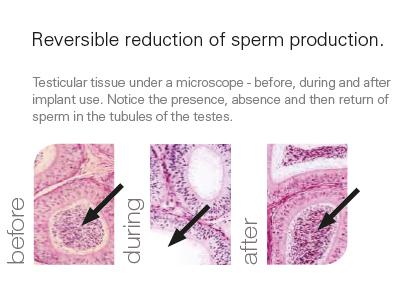
In clinical trials, more than 80% of dogs implanted with the 4.7mg Suprelorin returned to normal plasma testosterone levels (≥0.4ng/ml) within 12 months of implantation, and 98% by 18 months. In dogs given the 9.4mg implant, 68% returned to normal testosterone levels within 2 years and 95% by 2.5 years. Once normal testosterone levels have been established, fertility does not instantly return to normal as spermatogenesis generally takes 7-9 weeks in the dog. After recovery, the seminiferous tubules, epididymal ducts and prostate tissue all show functional activity
1. Mo Gannon & Associates (2017) Do you think neutering is harmful for dogs? MG&A.
2. Harris interactive (2017). Understanding the usages & attitudes around cats & dogs sterilization and evaluating the potential of Suprelorin.
3. DePalatis L. et al. Plasma concentrations of testosterone and LH in the male dog. Journal of Reproduction and Fertility 1978;52:201-207
4. Padula A.M. GnRH analogues – agonists and antagonists. Animal Reproduction Science 2005;88 (1-2):115-126.
5. Trigg T. E. (2002) Trial report PT14: Suprelorin clinical study report.
6. Spain C, Scarlett J. and Houpt K. Long-term risks and benefits of early-age gonadectomy in dogs. Journal of the American Veterinary Medical Association 2004;224:380-387.
Contact support teams with any question by phone or via our quick form.
Contact support teams with any question by phone or via our quick form.
This content is intended exclusively for veterinary professionals. Please log in to your account or register for free to read the full article and access resources.
File type: PDF
File size: 1.3 MB
File type: PDF
File size: 419.0 KB
File type: PDF
File size: 154.9 KB

Get updates on Virbac products, access the latest CPD training modules, and receive resources to support your practice.
Yes, I would like to receive email updates on Virbac products, free CPD modules, and practice support resources. You can unsubscribe at any time via the link in our emails.
Find information and products for your clients
on the Virbac pet owner website
Too many requests
Details: cache-cmh1290064-CMH 1794584300 3829871437
Varnish cache server